
Unlicensed Casino Chargebacks: Is a Missing UK Licence Enough for a Refund?
A missing licence does not establish an automatic card-deposit refund. Learn how to document licensing concerns and prepare a factual request for your bank.
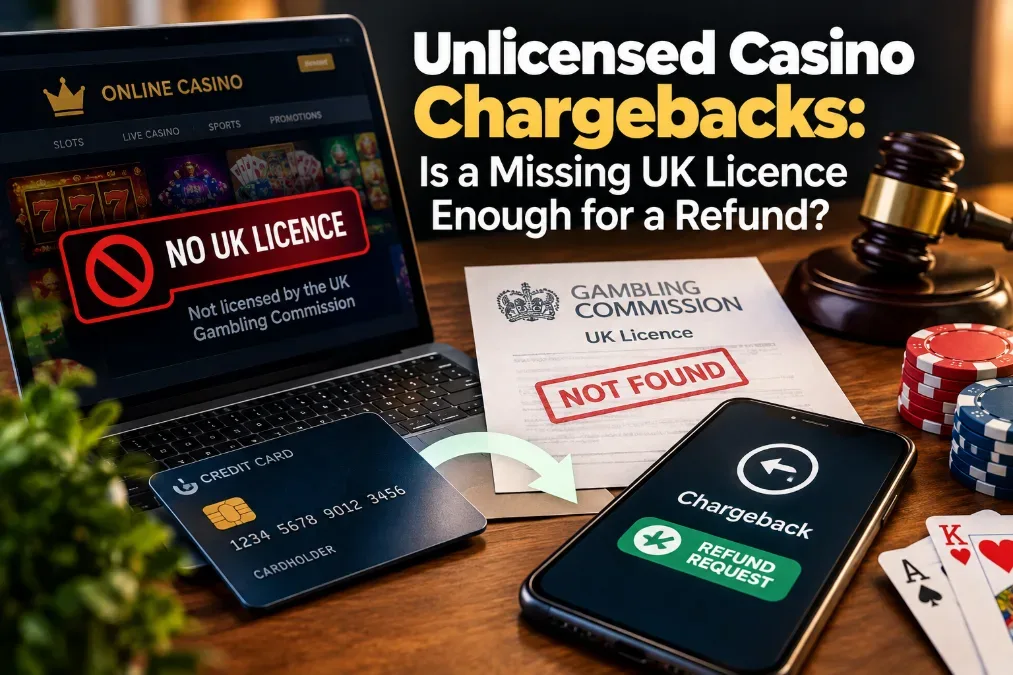
A missing Gambling Commission licence is not something to treat as an automatic refund entitlement. The evidence available for this guide does not establish that licensing status alone is a valid chargeback ground—or that every deposit dispute involving an unlicensed casino must fail.
For players in Great Britain, the practical approach is to separate two questions: what can you establish about the operator’s licensing status, and what basis will your card issuer consider for disputing the specific payment? An unlicensed casino chargeback request should explain both, without presenting one as proof of the other.
This guide concerns card deposits, not recovery of winnings. It offers an evidence-preparation framework, not a determination of your rights under a particular bank’s or card scheme’s rules.
Is a missing UK licence enough for a refund?
Do not assume so. Nothing in the supplied official material establishes a stand-alone right to an unlicensed casino refund through chargeback. Equally, that material does not establish that a bank must reject every such request.
Ask your card issuer to identify the applicable dispute route and assess the transaction’s circumstances. Describe what happened rather than choosing a label simply because it sounds more likely to succeed.
Keep these issues separate:
| Issue | What to establish | What not to assume |
|---|---|---|
| Licensing status | The business, domain, relevant product and relevant dates | That a missing search result proves the complete licensing history |
| Card payment | The transaction date, amount, currency and statement description | That the statement description necessarily identifies the casino’s legal entity |
| Dispute basis | The specific problem you want the bank to assess | That “unlicensed” supplies every element required for a chargeback |
| Requested remedy | Which deposit transactions you are disputing | That the entire gambling account balance is the disputed card payment |
Use this as an organising framework, not as a list of bank-approved chargeback grounds.
Check the operator’s identity before drawing conclusions
The Gambling Commission’s business register supports searches by business name, trading name, domain name or account number. It identifies the account number as the business’s unique reference and the account-name field as its legal name. These give you several ways to investigate a website’s stated operator. Source: Gambling Commission register
Start with the exact domain you used. Then check the trading name, legal business name and any account number displayed in the site’s terms or footer. Save the details you searched, the results and the date of your search. If you cannot confidently connect the website to a business, record that uncertainty rather than filling the gap yourself.
The register warns that gambling businesses supply domain and trading names, and that the Commission cannot guarantee the accuracy of third-party information. Consequently, do not present a single unsuccessful domain search as conclusive proof of an operator’s complete position. Source: register accuracy warning
Match the evidence to the deposit date
The register defines Active as a licence that is active and up to date. Pending means a new licence has been applied for or is being varied and is not yet active. Its product fields also distinguish the date a business was most recently licensed to operate a product from the date it stopped operating that product. Source: register definitions
Keep today’s search date separate from your payment date. Do not claim that a current result, by itself, establishes the position when an earlier deposit was made. Where the historical position remains unclear, explain that limitation to the bank.
Compare casino offers
18+ Play responsibly. Casino Terms & Conditions apply. We may earn a commission through affiliate links on this site.
Slotoro
Welcome Bonus up to €2,500 + 250 Free Spins
Wager: 40x Minimum Deposit: 25 €
View offerRead Review
V.vegas
Up to €4,000 EUR Welcome Bonus + 450 Free Spins
Wager: 40x Minimum Deposit: 10 €
View offerRead ReviewDescribe the payment problem accurately
For a casino deposit dispute, write a short factual account before making an argument about licensing. Address these questions:
- Did you authorise the card payment?
- What amount and currency appear on your statement?
- Was the deposit credited to the casino account?
- Was that balance subsequently used for gambling?
- What specific representation or transaction problem are you relying on?
- What response, if any, did the operator give?
These are suggested preparation questions, not confirmed eligibility tests. The supplied sources do not set out the applicable bank or card-scheme rules.
Do not describe an authorised deposit as unauthorised because you later discovered a licensing concern. If you genuinely did not authorise a payment, tell the bank that clearly. If you did authorise it, explain the actual concern without changing that fact.
Likewise, distinguish a disputed deposit from subsequent gambling results. Do not use losses, game mathematics or a disappointing session as a substitute for explaining the payment issue you want assessed.
Prepare a focused casino chargeback evidence file
The following is an editorial checklist, not a statement of what every bank requires. Ask your issuer which items it needs and how to submit them securely.
Payment and account records
Save the relevant statement entries, transaction references, deposit confirmations and casino account history. Keep the original currency and dates visible. Where a statement description differs from the casino brand, flag the mismatch and ask the bank to help identify the payment rather than guessing.
Identify each disputed deposit separately. Do not substitute a screenshot of an overall account balance for the underlying payment records.
Licensing and representation evidence
Save the exact website address, the operator details shown in the terms, any licence claims displayed when you deposited, and your register-search records. Distinguish material captured at the time of payment from material collected later.
If you allege that a statement was misleading, quote its wording and explain when you saw it. Avoid strengthening “I could not locate a matching register entry” into “the regulator confirmed this operator was unlicensed” unless you actually have that confirmation.
Correspondence and chronology
Keep your messages to the casino and its replies, including any request concerning the disputed deposit. If you have not contacted it, say so and ask the bank whether contact is needed for the route it is considering.
Prepare a brief chronology: deposit, discovery of the concern, contact with the operator, response and contact with the bank. Preserve complete records alongside any summary. For help structuring correspondence, see Casino Complaints and ADR: Building a Solid Evidence-Based Dispute; use it as a companion on documentation, not proof of chargeback eligibility.
What to ask your bank
Contact your issuer promptly rather than waiting to assemble a perfect dossier. No applicable procedural deadline is established by the sources for this guide, so ask the bank directly about timing.
A factual opening could be:
I want to ask whether these card deposits can be disputed. I authorised the payments, but I have concerns about the casino’s stated licensing position. My specific concern is [describe it]. I have attached the payment records, relevant website statements and register-search evidence. Please explain whether a dispute route applies and what further information you need.
Use that wording only if it accurately describes your situation. Ask the bank to clarify:
- Which dispute basis, if any, it is considering.
- What evidence is required and where to submit it.
- Whether any operator contact is necessary.
- Which deadlines apply to your circumstances.
- If it declines the request, the reason and any available review or complaint route.
Keep the conclusion narrower than the evidence
Do not treat questions published on an official website as regulatory findings. For example, the supplied Gambling Commission “overseas operators” FOI response refuses to proceed under section 14(1) of the Freedom of Information Act; it does not resolve the requester’s questions about deposit restitution or payment disputes. Source: overseas-operators FOI response
The strongest approach is a precise, honest request for assessment: identify the payments, document the licensing concern, explain the actual problem and ask the bank to apply its relevant rules. A missing licence should not be presented as a refund guarantee, and uncertainty should not be presented as proof that no dispute is possible.
While checking the position, avoid making further deposits to test the site or strengthen your case. Before considering another operator, use the pre-deposit checklist for Great Britain.
💬 Community
Join our official Telegram community:https://t.me/casinorank_fun
About the CasinoRank.fun Editorial Team
Articles are informational. Check cited sources, applicable terms and update dates.