Three Card Poker Rules: Dealer Qualification, Ante/Play and Pair Plus
Understand queen-high dealer qualification, Ante/Play settlement and separate Pair Plus evaluation, with a hypothetical ledger and implementation checks.
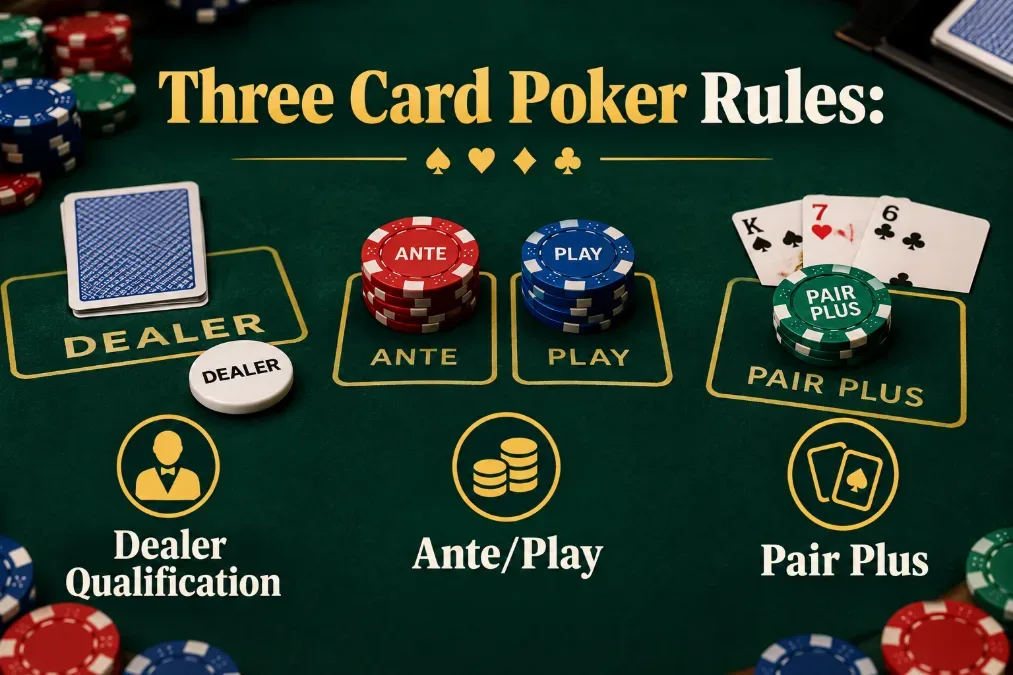
Three Card Poker Rules: Dealer Qualification, Ante/Play and Pair Plus
Three Card Poker is easier to follow when you separate two questions: how the dealer qualifies for the main game, and how each wager is evaluated. Evolution’s Three Card Poker overview identifies queen high as the dealer’s qualification threshold and says its side bets are evaluated separately. A side-bet win should therefore not be read as a statement about the result of every wager in the round. Source: Evolution Three Card Poker overview
There is an important evidence boundary here. The supplied Three Card Poker overview does not contain a complete Ante/Play settlement schedule. The detailed rules available for this article concern Evolution Teen Patti, not a separately documented Three Card Poker implementation. The explanation below identifies that distinction rather than presenting those rules as independently verified for every Three Card Poker table.
Dealer qualification: what queen high means here
For Three Card Poker dealer qualification, Evolution’s overview says the dealer must get “Queen High” to play. Its Teen Patti rules make the threshold explicit as queen high or better. Qualification is a condition for the dealer’s participation in the main-hand comparison; it is not a requirement that the player beat the dealer to win a separately evaluated side bet. Sources: Three Card Poker overview, Teen Patti rules
Keep qualification separate from settlement. In the documented Teen Patti rules, a dealer below the threshold does not simply cause both main wagers to win: the Ante pays 1:1 while the Play bet pushes. That distinction is why the dealer’s qualification status matters before comparing the two hands. Source: Teen Patti rules
For a selected Three Card Poker game, confirm that its own rules specify this same treatment. The overview alone does not establish the complete settlement sequence.
Ante and Play: continuing, folding and settlement
The Play stake matches the Ante
Evolution’s Teen Patti instructions say that, after examining the three cards, the player must either place a Play bet equal to the Ante or fold. Folding means not continuing and forfeiting the Ante. These are the supplied detailed instructions relevant to understanding the Ante/Play structure; check their applicability in the Three Card Poker game you intend to play. Source: Teen Patti rules
The decision should not be confused with adding another side bet. Under those instructions, Play is the matching main-game wager required to continue. Pair Plus has a separate evaluation, discussed below.
Main-wager settlement table
The following table reproduces the documented Evolution Teen Patti settlement structure. It is a reference for checking a Three Card Poker rules screen, not proof that every implementation uses identical terms.
| Outcome | Ante | Play |
|---|---|---|
| Player folds | Forfeited | No Play wager is placed |
| Player continues; dealer does not qualify | Pays 1:1 | Pushes |
| Dealer qualifies; player has the higher-ranking hand | Pays 1:1 | Pays 1:1 |
| Dealer qualifies; dealer has the higher-ranking hand | Lost | Lost |
| Dealer qualifies; hands have equal ranking | Pushes | Pushes |
Source for all settlement rows: Evolution Teen Patti rules
The table retains the source’s terms “push” and “1:1.” The supplied excerpts do not expressly define how returned stakes are displayed alongside winnings. Check that accounting in the selected game’s help panel rather than assuming that a displayed payment is entirely profit.
Compare casino offers
18+ Play responsibly. Casino Terms & Conditions apply. We may earn a commission through affiliate links on this site.

Slotoro
Welcome Bonus up to €2,500 + 250 Free Spins
Wager: 40x Minimum Deposit: 25 €
View offerRead Review
V.vegas
Up to €4,000 EUR Welcome Bonus + 450 Free Spins
Wager: 40x Minimum Deposit: 10 €
View offerRead ReviewPair Plus rules: a separate hand-based wager
Evolution’s Three Card Poker overview says Pair Plus is evaluated separately at the end of the game. The detailed Teen Patti page describes its Pair Plus requirement as making a pair or better from the player’s own three cards and says side bets are evaluated separately from the main bet. Sources: Three Card Poker overview, Teen Patti rules
That distinction separates two tests:
- Ante/Play: apply the qualification and hand-comparison rules documented for the game.
- Pair Plus: evaluate the player’s hand against the applicable side-bet requirements and paytable, rather than requiring that hand to beat the dealer.
A complete Pair Plus paytable was not supplied. Consequently, this article does not quote payouts for individual hand categories as verified Three Card Poker rates. Read the actual paytable before staking money.
Separate evaluation does not establish what happens after folding. The supplied overview does not resolve whether a folded hand remains eligible for Pair Plus. Check the game’s folding and side-bet eligibility conditions together; do not infer the answer from the word “separate.”
Pair Plus is not the Ante Bonus
Evolution’s Three Card Poker overview also describes an Ante Bonus for a straight or better, regardless of the dealer’s hand. That is a separately described feature, not the Pair Plus wager. Source: Three Card Poker overview
The Teen Patti rules additionally require a Play bet to receive that game’s Ante Bonus. This is an implementation-specific condition worth checking, not a condition established for every Three Card Poker version by the supplied overview. Source: Teen Patti rules
Hypothetical round ledger: a winning side bet, an overall loss
Everything in this example is hypothetical. Assume a player stakes 10 units on Ante, continues with 10 units on Play, and has already placed 5 units on Pair Plus. Assume the player has a pair, the dealer has a higher pair and qualifies, and both main wagers lose.
For this illustration only, assume Pair Plus awards 5 units of profit on the 5-unit stake, with that stake also returned. This represents an assumed 1:1 profit payment, not a verified paytable. No other wager or award applies. “Gross returned” below includes any returned stake; “net result” means gross returned minus the amount staked.
| Wager | Stake | Assumed gross returned | Net result |
|---|---|---|---|
| Ante | 10 units | 0 units | −10 units |
| Play | 10 units | 0 units | −10 units |
| Pair Plus | 5 units | 10 units | +5 units |
| Whole round | 25 units | 10 units | −15 units |
The Pair Plus return is 5 units of assumed profit plus the 5-unit stake. Total stakes are 10 + 10 + 5 = 25 units; total returns are 0 + 0 + 10 = 10 units. The overall result is therefore 10 − 25 = −15 units.
The side bet wins in this constructed round, but the round loses money overall. Evaluate the combined ledger, not just the wager carrying a winning label. For a practical framework for planning spending, see How to Set a Gambling Budget.
What to verify before playing
Use the selected game’s rules and paytable to check:
- The dealer’s qualification threshold and the treatment of both main wagers when the dealer does not qualify.
- Whether Play must match Ante, plus the stated win, loss and tie outcomes.
- Pair Plus payouts, eligibility and any effect of folding.
- Any Ante Bonus requirements, including whether placing Play is necessary.
- Whether displayed returns include the original stake.
The supplied passages do not identify applicable jurisdictions or rule-effective dates. Treat them as evidence for the named Evolution games, not as a universal or dated certification of Three Card Poker rules. The key reading discipline is to keep qualification, main-wager settlement, side-bet eligibility and whole-round profit separate.
💬 Community
Join our official Telegram community:https://t.me/casinorank_fun
About the CasinoRank.fun Editorial Team
Articles are informational. Check cited sources, applicable terms and update dates.